

 Updated on Oct, 2025
 Language - English
great
Fundamentals of Object Oriented Programming with C++
Learn C++ syntax basics and modern Object-Oriented Programming techniques and tips
 Development ,Programming Languages,C++
Lectures -68
Duration -7 hours
Lifetime Access

Lifetime Access
30-days Money-Back Guarantee
Get your team access to 10000+ top Tutorials Point courses anytime, anywhere.
Course Description
Fundamentals of Object-Oriented Programming: C++ is a course designed to introduce students to the principles of object-oriented programming (OOP) using the C++ programming language. This course is suitable for students who have a basic understanding of programming concepts but may not have prior experience with OOP.
In this course, students will learn the fundamental concepts of OOP, including encapsulation, inheritance, and polymorphism. They will also learn how to design and implement classes, objects, and functions in C++, and how to use them to solve real-world problems.
Throughout the course, students will work on a variety of hands-on projects and exercises to practice their skills and apply their knowledge to real-world situations. They will also learn best practices for writing efficient and maintainable C++ code.
Upon completion of this course, students will have a strong foundation in OOP and be able to use C++ to design and implement object-oriented programs.
Course Objectives:
The course is designed to provide complete knowledge of Object-Oriented Programming through C++ and to enhance the programming skills of the students by giving practical assignments to be done in labs.
To learn how to write functions for efficiency and performance.
To understand how C++ improves C with object-oriented features.
To learn the syntax and semantics of the C++ programming language.
To learn how to design C++ classes for code reuse.
To learn how to implement copy constructors and class member functions.
To understand the concept of data abstraction and encapsulation.
To learn how to overload functions and operators in C++.
To learn how inheritance and virtual functions implement dynamic binding with polymorphism.
To learn how to design and implement generic classes with C++ templates.
To learn how to use exception handling in C++ programs.
C++ real-world use cases:
GUI Applications
Operating Systems
Web Browsers and Utilities
Database Management Systems
Libraries – Machine learning, AR/VR
Cloud Computing & Distributed Applications
Game Development
Who this course is for?
- Beginner and Novice programmers who would like to develop a basic understanding of how to write simple Object-Oriented programs in C++
- Hobbyists, creatives, or people who just love learning and want to understand how software systems work
- Anyone looking to advance their career and increase their earning potential
Goals
Understand the purpose of OOP, the history of the C++ programming language, the anatomy of a C++ program, and the role of the compiler.
Learn how to use C++ syntax to store, process, and retrieve data, take input from a user and provide output by writing simple programs.
Use the built-in STD & STL libraries to process input and data, create custom libraries, file handling, and defensive programming techniques.
Construct complex - real-world object-oriented classes and solutions in C++ based on UML diagrams.
Learn core programming concepts that will improve logical reasoning, critical thinking & problem-solving skills and equip you for your first Jr Developer Role.
Prerequisites
No programming experience is needed. Basic understanding of Data Flow & UML Diagrams.
Access to a Personal Computer and an Internet connection.
The enthusiasm and drive to learn and succeed.

Curriculum
Check out the detailed breakdown of what’s inside the course
Module 1
14 Lectures
-
 Introduction: Module 1 Objectives
15:14
15:14
Introduction: Module 1 Objectives
15:14
15:14
-
Environment Setup & First Run
13:25
13:25
-
Data Types
04:25
04:25
-
Char
03:17
03:17
-
Strings: C-Style
06:20
06:20
-
User Input: Getline Function
05:12
05:12
-
Stringstream
04:05
04:05
-
Arithmetic Operators
06:24
06:24
-
Logical - Relational - Boolean Operators
07:08
07:08
-
Numeric Input Validation: CIN.GOOD()
04:17
04:17
-
Simple Addition Program
09:36
09:36
-
Fahrenheit to Celsius Conversion Program
04:18
04:18
-
Constants: Area of Circle Program
02:58
02:58
-
Module 1 Summary
00:33
00:33
Module 2
25 Lectures

Module 3
19 Lectures
Module 4
9 Lectures
Next Steps
1 Lectures
Instructor Details

Doxa Anthony
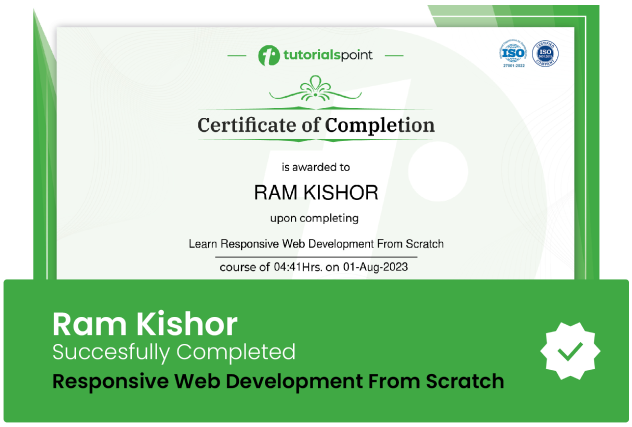
Course Certificate
Use your certificate to make a career change or to advance in your current career.
Our students work
with the Best

















Feedbacks
Related Video Courses
View MoreAnnual Membership
Become a valued member of Tutorials Point and enjoy unlimited access to our vast library of top-rated Video Courses
Subscribe now
Online Certifications
Master prominent technologies at full length and become a valued certified professional.
Explore Now