
- Trending Categories
 Data Structure
 Networking
 RDBMS
RDBMS Operating System
 Java
Java MS Excel
 iOS
iOS HTML
HTML CSS
CSS Android
 Python
 C Programming
 C++
C++ C#
C# MongoDB
 MySQL
MySQL Javascript
 PHP
PHP Physics
 Chemistry
 Biology
 Mathematics
 English
 Economics
 Psychology
 Social Studies
 Fashion Studies
 Legal Studies
- Selected Reading
- UPSC IAS Exams Notes
- Developer's Best Practices
- Questions and Answers
- Effective Resume Writing
- HR Interview Questions
- Computer Glossary
- Who is Who
Explain the balancing parenthesis of PDA
Pushdown Automata (PDA) are the finite automata (FAs), but with the ability to push and pop symbols to/from a stack.
PDA accepts strings if there is a legal path from start state to acceptance state for input. Otherwise, the string is rejected.
A PDA can be represented by a 7-tuple
(Q, ∑, ?, q0, ha, ?,δ)
Where
The PDA is to finite subsets of Q ? (? ∪ {?})*.
Parentheses are balanced if
- While reading string, number of opening parentheses >= number of closing parentheses.
- When string is read, number of opening parentheses = number of closing parentheses.
Examples
- (())() − Balanced
- ((()() − Not balanced
- )()(() − Not balanced
The context free grammar (CFG) is as follows −
S -> (S) | SS | ε
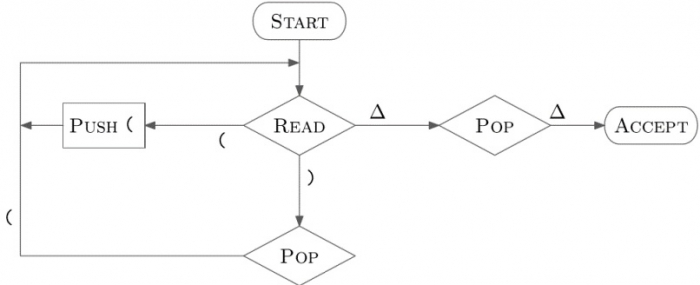
PDA for balancing brackets
Each (is pushed, each) causes an (to be popped). This is shown below

Updated on: 2021-06-16T13:04:29+05:30
6K+ Views

Advertisements