
- Trending Categories
 Data Structure
 Networking
 RDBMS
RDBMS Operating System
 Java
Java MS Excel
 iOS
iOS HTML
HTML CSS
CSS Android
 Python
 C Programming
 C++
C++ C#
C# MongoDB
 MySQL
MySQL Javascript
 PHP
PHP Physics
 Chemistry
 Biology
 Mathematics
 English
 Economics
 Psychology
 Social Studies
 Fashion Studies
 Legal Studies
- Selected Reading
- UPSC IAS Exams Notes
- Developer's Best Practices
- Questions and Answers
- Effective Resume Writing
- HR Interview Questions
- Computer Glossary
- Who is Who
Explain the elimination of epsilon productions in CFG
All grammars are not always optimized, which means the grammar may consist of some extra symbols (non-terminals) which increase the length of grammar.
So, we have to reduce the grammar by removing the useless symbols.
Properties
The properties to reduce grammar are explained below −
- Each non-terminal and terminal of G appears in the derivation of some word in L.
- There should not be any production as X->Y where X and Y are non-terminals.
- If epsilon is not in language L then there need not be in the production X-> ε.
The diagram given below depicts the use of reduce grammar−
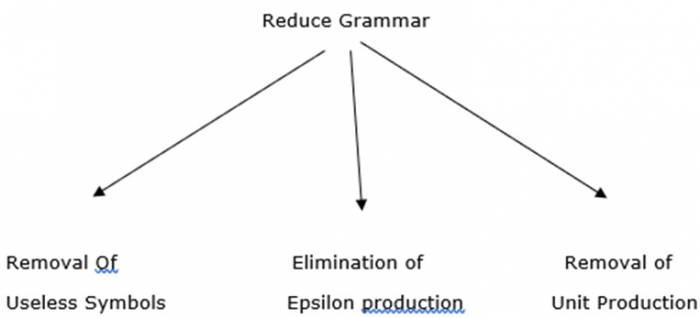
The productions of type S-> ε are called ε productions
These types of production can only be removed from the grammars that do not generate ε
Step 1
First find all null-able non terminals which derive.
Step 2
For each production A->a construct all productions A. where X is obtained from 'a' by removing 1 or more non-terminals from step 1.
Step 3
Now combine the result of step 2 with the original production and remove ε production.
Example
S->XYX
X->0X| ε
Y->1Y| ε
Explanation
While removing ε production we are deleting the rule X-> ε and Y-> ε
To preserve the meaning of CFG we are placing ε at right hand side wherever X and Y appear
S->XYX
If the first X at the right hand side is ε
S->YX
Similarly, if the last X at the right hand side is ε
S->XY
If Y= ε,
S->XX
If both Y and X are ε,
S->X
If both x are replaced,
S->Y
Now S->XY|YX|XX|X|Y
Now let us consider,
X->0X| ε
If we replace ε at right hand side for X then,
X->0X|0
Similarly Y->1Y|1
The CFG with removal of epsilon production as follows,
S->XY|YX|XX|X|Y
X->0X|0
Y->1Y|1

11K+ Views
