
- Trending Categories
 Data Structure
 Networking
 RDBMS
RDBMS Operating System
 Java
Java MS Excel
 iOS
iOS HTML
HTML CSS
CSS Android
 Python
 C Programming
 C++
C++ C#
C# MongoDB
 MySQL
MySQL Javascript
 PHP
PHP Physics
 Chemistry
 Biology
 Mathematics
 English
 Economics
 Psychology
 Social Studies
 Fashion Studies
 Legal Studies
- Selected Reading
- UPSC IAS Exams Notes
- Developer's Best Practices
- Questions and Answers
- Effective Resume Writing
- HR Interview Questions
- Computer Glossary
- Who is Who
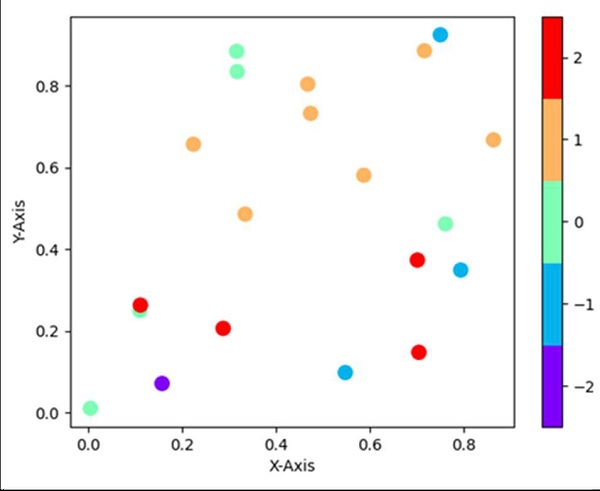
How to make a discrete colorbar for a scatter plot in matplotlib?
Using plt.colorbar(ticks=np.linspace(-2, 2, 5)), we can create a discrete color bar.
Steps
Return random floats in the half open interval, i.e., x, using np.random.random method.
Return random floats in the half open interval, i.e., y, using np.random.random method.
Return random integers from `low` (inclusive) to `high` (exclusive), i.e., z, using np.random.randint(-2, 3, 20) method.
Set the X-axis label using plt.xlabel().
Set the Y-axis label using plt.ylabel().
Use the built-in rainbow colormap.
Generate a colormap index based on discrete intervals.
A scatter plot of *y* vs. *x* with varying marker size and/or color, with x, y and z are created (Steps 1, 2, 3).
Create a colorbar for a ScalarMappable instance, *mappable*.
Use plt.show() to show the figure.
Example
from matplotlib import pyplot as plt
import numpy as np
from matplotlib import colors

x = np.random.random(20)
y = np.random.random(20)
z = np.random.randint(-2, 3, 20)

plt.xlabel('X-axis ')
plt.ylabel('Y-axis ')

cmap = plt.cm.rainbow
norm = colors.BoundaryNorm(np.arange(-2.5, 3, 1), cmap.N)

plt.scatter(x, y, c=z, cmap=cmap, norm=norm, s=100, edgecolor='none')
plt.colorbar(ticks=np.linspace(-2, 2, 5))

plt.show()
Output

8K+ Views
