
- Trending Categories
 Data Structure
 Networking
 RDBMS
RDBMS Operating System
 Java
Java MS Excel
 iOS
iOS HTML
HTML CSS
CSS Android
 Python
 C Programming
 C++
C++ C#
C# MongoDB
 MySQL
MySQL Javascript
 PHP
PHP Physics
 Chemistry
 Biology
 Mathematics
 English
 Economics
 Psychology
 Social Studies
 Fashion Studies
 Legal Studies
- Selected Reading
- UPSC IAS Exams Notes
- Developer's Best Practices
- Questions and Answers
- Effective Resume Writing
- HR Interview Questions
- Computer Glossary
- Who is Who
issuperset() in Python
In this article, we will learn about issuperset() in Python and its implementation in various areas.
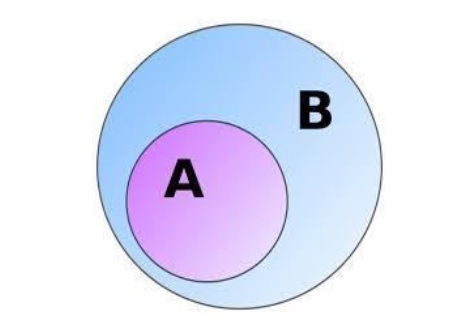
This method returns boolean True if all elements of a set B contains all elements set A which is passed as an argument and returns false if all elements of A not present in B.
This means if B is a superset of A then it
returns true;
else False
Example
Let’s look at some example
A = {'t','u','t','o','r','i','a','l'}
B = {'t','u','t'}
print("A issuperset B : ", A.issuperset(B))
print("B issuperset A : ", B.issuperset(A))
Output
A issuperset B : True
B issuperset A : False
Example
A = {'t','u','t','o','r','i','a','l'}
B = {'t','u','t'}
C = {'o','r','i','a','l'}
print("A issuperset B : ", A.issuperset(B))
print("B issuperset A : ", B.issuperset(A))
print("A issuperset C : ", A.issuperset(C))
print("B issuperset C : ", B.issuperset(C))
Output
A issuperset B : True
B issuperset A : False
A issuperset C : True
B issuperset C : False
Conclusion
In this article, we learnt how to implement the issuperset() function in Python 3.x. Or earlier.

Updated on: 2019-08-29T10:48:29+05:30
142 Views

Advertisements