
- Trending Categories
 Data Structure
 Networking
 RDBMS
RDBMS Operating System
 Java
Java MS Excel
 iOS
iOS HTML
HTML CSS
CSS Android
 Python
 C Programming
 C++
C++ C#
C# MongoDB
 MySQL
MySQL Javascript
 PHP
PHP Physics
 Chemistry
 Biology
 Mathematics
 English
 Economics
 Psychology
 Social Studies
 Fashion Studies
 Legal Studies
- Selected Reading
- UPSC IAS Exams Notes
- Developer's Best Practices
- Questions and Answers
- Effective Resume Writing
- HR Interview Questions
- Computer Glossary
- Who is Who
What is Thin Ethernet?
Thin Ethernet, popularly known as cheapernet or thinnet, is among the family of Ethernet standards that uses thinner coaxial cable as a transmission media. It is technically known as 10-BASE-2. Here, 10 is the maximum throughput, i.e. 10 Mbps, BASE denoted use of baseband transmission, and 2 refers to the maximum segment length of about 200 metres (precisely 185 metres).
This type of cabling allows a maximum of 30 stations to be connected to it by BNC connectors with 50 centimetres minimum gap between subsequent stations.
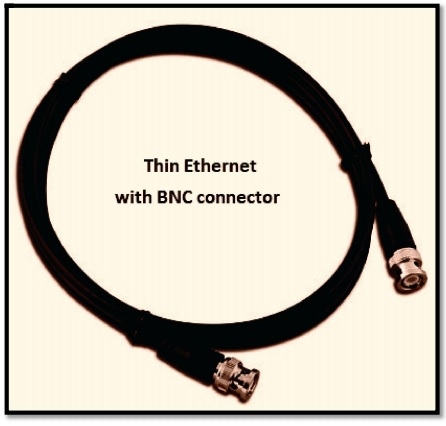
Features of Cable and Network
The salient features of 10-BASE-2 Ethernet cabling are −
10-BASE-2 use RG-58 A/U coaxial cable. It is thinner, more flexible, more economic and easier to install than the coaxial cable used in thick Ethernet.
The cable has 10 Mbps transmission speed.
The maximum segment length is 185 m and the minimum gap between stations is 50 cm.
The maximum number of stations that can be connected is restricted to 30.
Thinnet uses Manchester coding. A low-to-high transition in the middle of the bit period is encoded as binary 0 while a high-to-low transition in the middle of the bit period is encoded as binary 1.
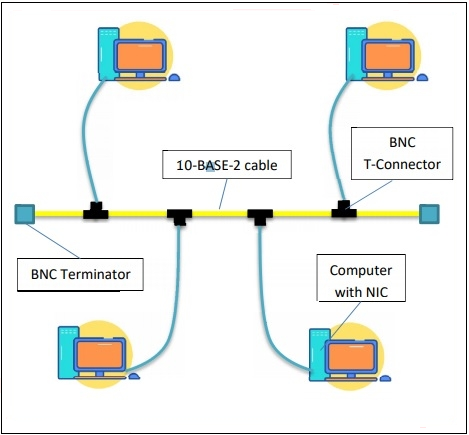
It uses BNC T-connector for connecting with the stations network interface card (NIC) and also for joining cables.
The thin coaxial cable is terminated by a 50 ohm resistor at both the ends.
Thin Ethernet network is shown in the following diagram −

2K+ Views
